Project Description
MPH
SEATS
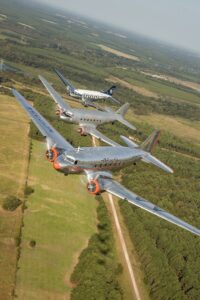
Douglas DC-3
Role: Transport Aircraft
National Origin: United States
Manufacturer: Douglas Aircraft Company
First Flight: 1936
Number Built: 10,655 (all Douglas variants)
The Douglas DC-3 was an all-metal, low-winged, transport monoplane with a selection of many interior arrangements. The standard day-coach layout was 21 passengers in 3 rows of seats, with 7 seats in each row. This version was the most popular and used by most of the airlines here and abroad. The so-called “Club” version seated 14 passengers, 7 on each side of a center aisle, in overstuffed swiveling arm-chairs that offered room and comfort never before available for a reasonable fare. The “Club” flights did charge a little extra fare, but the service became very popular, especially on runs from New York to Chicago and runs from New York to Miami. The crew for all flights was pilot, a co-pilot, and a stewardess. All of the major airlines were equipped with some DC-3 by 1937, and all airlines kept ordering more and more to keep pace with increases in air travel; air travel was gaining popularity by leaps and bounds. In May of 1937 the scheduled airlines of America carried 98,000 passengers, and the following summer months were even better. Passengers who experienced the delight of traveling by DC-3 were the best advertisers, they told everyone; this kind of endorsement snow-balled into a million passengers, many of whom became regular commuters.
As powered with 2 of the 9 cylinder Wright “Cyclone” GR-1820-G2 engines rated 850 h.p. each the DC3-G2 delivered premium performance with the greatest economy, a happy combination that made money for the airlines. As engine development forged forward performance of the DC-3 was also improving: consequently, the DC3-G102 as powered with 2 of the Wright “Cyclone” GR-1820-G102 engines rated 900h.p. each was the one being ordered in 1937. The Wright “Cyclone” GR-1820-G103 engine was a highly supercharged (high altitude) version developed for Pan Am whose routes operated generally at very high altitudes in countries south of our border. By 1939 the big 9 cylinder Wright “Cyclone” was operating at 1000 h.p. (1200 h.p. for takeoff) and that was nearing the limit for a single-row “radial” engine; all engines of higher power soon became “two-row radials” of larger displacement.
Many think of the DC-3 as just one kind of airplane, but it was available with so many different engines and outfitted for so many different jobs that it actually became many different airplanes; pilots claim they had to get reacquainted with each “Cyclone” powered DC-3. Certificate for the DC-3 was issued 8-27-36 and some 265 or more examples, including 81 for export, were manufactured by the Douglas Aircraft Company Inc. on Clover Field in Santa Monica, Calif. A note of interest: the second DC-3 was delivered to American Airlines in July of 1936, they sold it to Ozark Air Lines in 1950; it had worn out 50 sets of engines by then!
(Excerpts from the U.S. Civil Aircraft Series by Joseph Juptner)
The American Airlines Flagship Detroit was built in early 1937 and the airline took delivery of the Detroit on March 2, 1937. The airplane was designated as a Douglas DC-3-G102. It was the 24th DC-3 in American’s fleet of eighty-four aircraft in that order. American Airlines flew the Detroit in regular passenger service until 1947. Since the airplane was not drafted into military service during World War II, American featured the airplane in advertisements during the early 1940’s.
Flagship Detroit joined the Mid America Flight Museum collection in October of 2026.
General characteristics
- Crew: 2 pilots
- Capacity: 21 passengers
- Length: 64 ft 6 in
- Wingspan: 95 ft
- Height: 16 ft 11 in
- Empty weight: 15,300 lb
- Useful load: 8,700 lb
- Powerplant: 2 × Wright R-1820 radial engines, 900 hp
Performance
- Maximum speed: 212 mph
- Range: 1260 miles at 180 mph
- Service ceiling: 20,800 ft