Project Description
MPH
SEATS
Beechcraft Model 17
Role: Transport Aircraft
National Origin: United States
Manufacturer: Beech Aircraft Corporation
First Flight: 1935
Number Built: 4 of this model B17E
Some of the inquiring customers had a natural preference for the famed “Wright” engines, and especially the 7 cylinder R-760-E1 engine rated 285 h.p., so Beech developed a new model designated B17E especially for these customers. Basically, the model B17E was quite typical of the (Jacobs-powered) B17B except for the installation of the Wright engine and a slight customizing to various other details. It has been often said that of the 15 or so important characteristics of an airplane, including price, Walter Beech put performance and quality at the top of the list: this was especially evident in the Wright-powered B17E. The 4-5 place B17E turned out to be a combination of rather uncommon beauty, a practical luxury in relative economy, and the fastest transportation available in this type of airplane. The B17E quickly appealed to sportsmen and many men of business, but Beech was also promoting new models coming up with higher horsepower, so oddly enough, many potential B17E customers took on an attitude of let’s-wait-and-see. Louise Thaden, famous aviatrix, was by now a Beech factory representative and had just made a demonstration tour out to the west-coast; she was well known out there and helped to sell a few airplanes. The Beech model B17E was a cabin biplane with seating arranged for 4 or 5; although a cabin biplane, it certainly was no ordinary cabin biplane, as we can see. Inverse (negative) stagger was the worldwide trade-mark of the Beech by now, and with its landing gear tucked up into the belly, it was still the most novel commercial airplane of this time. More speed per horsepower was its paramount feature, but quality, luxury, and premium performance were also built in to make it one of the best buys of the decade.
Ironically enough, the search for more speed and better performance was still tied-in directly to horsepower available, so despite the speed and performance the “Beech” was already delivering with 225 h.p. (B17L) there were always those that wanted just a little more. As if to satisfy this need in easy stages, Beech was going up on the horsepower in moderate amounts. As powered with the 7 cylinder Wright R-760-E1 engine rated 285 h.p. at 2100 r.p.m. the model B17E delivered substantial amounts of performance increase in proportion to the amount of power added. The extra 60 h.p. added 10 m.p.h. to the top speed, and all else (take-off, climb-out, etc.) was improved accordingly. The Wright engine was relatively expensive, so those that were willing to pay the difference, more or less expected the best of everything to go with it. In the B17E this is just what they got, the best of everything. The type certificate number for the model B17E was issued 5-9-35 and 4 examples of this model were manufactured by the Beech Aircraft Co. at Wichita, Kan. Walter H. Beech was pres.; R. K. Beech was V.P.; Wm. A. Ong was sales mgr.: Ted A. Wells was chief engineer. George Harte, local test-pilot, did testing for both Beech and Cessna during this period. Beech started out with 8 men in 1932, by mid-1934 the staff had swelled to 150 and former “Travel Air” employees were hired as fast as they came in. The construction details and general arrangement of the model B17E were typical to that of the B-17-L as described here in the chapter for ATC # 560. The following pertains to the Beech 17 series in general and the B17E in particular.
The large safety-glass windshield was curved and sloped to fit the streamlines of the fuselage. The lower fuselage was encased in a large metal wing fillet and the forward portion of the fuselage was covered in metal panels. Entry door was on the left side and an extra door was available for the right side. The front seats were adjustable and parachute-type seats were available. Baggage compartment for 125 lbs. was down low behind the rear seat with access door on left side of fuselage; the baggage compartment was limited to 75 lbs. when 3 persons.
(Excerpts from the U.S. Civil Aircraft Series by Joseph Juptner)
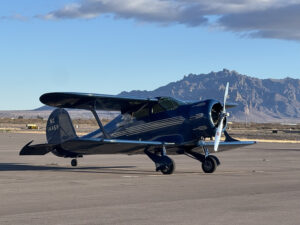
The museum’s Staggerwing is production number 49 and rolled out of the factory in 1935 wearing NC14458. This bright blue beauty joined the museum collection in 2025.
General characteristics
- Crew: 1 pilots
- Capacity: 3-4 passengers
- Length: 24 ft 5 in
- Wingspan: 32 ft
- Height: 8 ft 2 in
- Empty weight: 2,000 lb
- Loaded weight: 3,263 lb
- Powerplant: 1 × Wright R-670 radial engine, 285 hp
Performance
- Maximum speed: 185 mph
- Range: 680 miles at 165 mph
- Service ceiling: 18,000 ft
- Rate of climb: 1,200 ft/min