Project Description
MPH
WEAPONS
CREW
Boeing B-17G Flying Fortress
Role: Bomber
National Origin: United States
Manufacturer: Boeing (license built by Lockheed)
First Flight: 1935
Primary User: US Army Air Forces
Number Built: 12,731
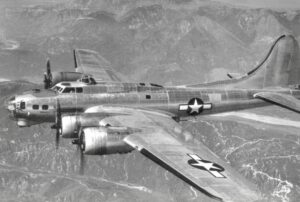
There will never be another aircraft like the B-17. When the Army set out its 1934 requirements for a bomber able to fly at 250 miles per hour, with a service ceiling of 25,000 feet and six to ten hours endurance, Boeing was ready to give it a try. Their highly successful Model 247 airliner had led to many advances and bridged many technical gaps. The company was already working on the giant XB-15, the largest aircraft to fly when it finally took off in 1937. So, while most manufacturers submitted twin-engine designs, the team under Edward C. Wells in Seattle started working on Model 299.
Construction began on August 16, 1934 and, borrowing liberally from the XB-15 and Model 247, Boeing produced a superb aircraft, free of the gawkiness which characterized so many bombers of the thirties. The first Fortress carried eight crew members, was powered by four 750 horsepower engines, and weighed 43,000 pounds. It was sixty-eight feet nine inches long, with a wingspan of nearly 104 feet, and there were four gun blisters, with provision for a fifth .30 caliber gun in the nose. The acid test took place on July 28, 1935, when test pilot Les Tower took Model 299 up for the first time. When the ninety minute test flight was over a lot of apprehension was gone and a of work justified. On August 20 the plane was taken to Wright aid for evaluation by the Air Corps. The Fortress easily matched up to the claims made for her. Suddenly, on October 30, the big silver plane stalled sickeningly into the ground on takeoff. As it burned fiercely the five crewmen were dragged out. Tower and the co-pilot, Major Ployer P. Hill, died. The investigation proved that the controls had been locked, unknown to the pilots, and when the aircraft lifted it became uncontrollable. Even so, the Air Corps’ projected order of sixty-five Fortresses was dropped and only thirteen examples were asked for, perhaps a temptation to fate in itself. With these thirteen YB-17’s the foundation to the legend was laid. One was assigned to Wright Field for destruction testing, the other twelve went to the G.H.Q. Air Force for America’s first heavy bomber group, the 2nd. In December 1936 Captain Stanley Umstead brought the first YB-17 into Seattle after a brief flight, and as onlookers groaned the steel and bronze brakes, quick to overheat, fused from overuse. The Fortress’ nose dug a two hundred and forty foot, $5,000 furrow. The B-17 could not have made a worse entry into the field of inter-service squabbling, miserly allocations, distrust of “strategic bombing” and general anti-military feeling that was prevalent in the United States.
The first production model of the bomber was the B-17B, and like all but the first, Model 299, it was powered by Wright Cyclone engines. The pneumatic brakes were dropped in favor of hydraulics, but little else was needed to be changed.When the Lend-Lease agreement was made, the Royal Air Force asked for the Fortress, and got twenty of the next model, the B-17C. The American bomber would first see action with the British.
The first B-17G was delivered to the USAAF in September 1943, and the chin turret was warmly received. Only the sight and remote firing control were inside the nose; the twin guns, recoil dampers, and gun chargers were all housed in the turret beneath the nose. The guns had an excellent field of fire and the nose was left virtually unobstructed. There were more than a score of “different” B-17G’s, but it was not until the B-17G-90-BO, B-17G-55-VE, and B-17G-50-DL that the next recognizable change took place. This was the installation of the Cheyenne tail turret, which was a ball-like turret with a better field of fire and a reflector gunsight in place of the old ring and bead. This stubby, round turret decreased the Fortress’ length by five inches. The B-17G was also the first model to have enclosed waist positions, in place of the earlier hatch which had to be slid back before the guns could be swung out. These waist windows varied – there were both flush fittings and “bulged” fittings. The waist positions were also staggered to allow the gunners more movement. The radio operator’s single hand-held gun had been of dubious value and toward the end of 1944 it was abandoned on the B-17G. Like the waist positions, this gun emplacement had been enclosed to decrease discomfort on most B-17G’s.
Being over a ton heavier than the B-17F, the B-17G suffered in comparative performance. While the B-17F was capable of nearly 300 mph at 25,000 feet, the B-17G was rated at 287 mph. With bombs and fuel and the necessities of formation flying the standard required was for B-17G’s to be able to operate at 25,000 feet for about six hours at around 160 mph average speed.
In all there were 12,731 Flying Fortresses – the Model 299, thirteen YB-17’s, one YB-17A, 39 B-17B’s, 38 B-17C’s, 42 B-17D’s, 512 B-17E’s, 3405 B-17F’s, and 8680B-17G’s. Now there are only a handful left.
(Excerpts from the book B-17 In Action by Steve Birdsall)
44-85718 did not see combat in World War Two. After the war it was sold to France and registered as F-BEEC. The next owner was based in the United Kingdom and it was registered as G-FORT. In 1987 it was flown to the United States and registered as N900RW. It joined the Mid American Flight Museum in 2021 and it currently in restoration in Madras, Oregon.
General characteristics
- Crew: 10
- Length: 74 ft 9 in
- Wingspan: 103 ft 9 in
- Height: 19 ft 2 in
- Empty weight: 6,000 lb
- Max. takeoff weight: 48,726 lb
- Powerplant: 4 × Wright R-1820 rated at 1,200 hp
- Propellers: 3-bladed Hamilton Standard constant-speed propeller
Performance
- Maximum speed: 302 mph
- Cruise speed: 160 mph
- Range: 3,750 miles
- Service ceiling: 35,000 ft