Project Description
MPH
SEATS
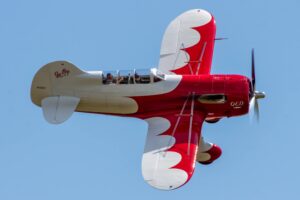
Gee Bee QED
Role: Sport Racing Aircraft
National Origin: United States
Manufacturer: Jim Moss and Granville Brothers Aircraft
First Flight: 2013
Number Built: 1
In January of 1934, Howell Miller completed a three-view general arrangement drawing of a new airplane: the Gee Bee International Super Sportster Model R-5. It had lines similar to the familiar R-1 and R-2; however, it was stretched’ considerably larger with a span of thirty feet and a length of twenty-two feet six inches. It was to be powered by a Pratt and Whitney Hornet that developed 850 horsepower. It was expected to have a top speed of 295 miles per hour. Cruise would be at 250 miles per hour for 1,850 miles. It seemed to be a likely candidate for the Mac Robertson race. Jacqueline Cochran said she was interested in an aircraft for the upcoming Mac Robertson race from London, England to Melbourne, Australia.
Miller’s International Sportster was shown to her and she liked the deluxe racer. The end result was, for all practical purposes, the Q.E.D. That is a Latin term and it stands for Quad Erat Demonstrandum, meaning “it is proven.” As later events were to prove, they could not have picked a bigger misnomer. Design predictions, based on calculations and experience, showed the ship would be fast powered with a Hornet. With the design finally frozen and Cochran putting up the money, construction got underway.
As it emerged from the shops, the big Lucky Strike green (Miss Cochran was a Lucky Strike girl in that cigarette’s magazine advertising) machine looked very much like its predecessors— only a whole lot bigger. It had not been designed completely as a racer however. It met all Department of Commerce requirements for a commercial rating. Since there was still time to fly the ship in the Bendix as a sort of long-distance shake down, orange racing numbers 77 (with a black pinstripe) were painted on along with the license number NR14307.
The QED did start the famed MacRobertson race but Cochran ran into trouble on several fronts and eventually dropped out of the race. The airframe changed hands several times and it was flown in the Bendix cross country race from California to Ohio. It finally proved it’s worth with Francisco Sarabia in May of 1939, flying from Mexico City to New York. That was a non stop flight of 10 hours and 38 minutes. On his way home departing his stop in Washington DC the engine quit and Sarabia perished in a water landing in the Potomac River. The QED was returned to Mexico to be restored and is on display as a tribute to Sarabia.
(Excerpts from the book The Gee Bee Racers by Mendenhall & Murphy)
The mystique of the many vintage racers caught the attention of Jim Moss. Moss went on to built several amazing replica racers. One of which is the museums QED. Moss and team built up the replica Gee Bee during 2002 to 2013. As a baseline for the project they followed original Howell Miller drawings. Hornet engines are very rare so a Wright 1820 was fitted to the airframe. With more power came needed modifications to the dimensions. The engine was moved back, cowled with a Grumman S2 Tracker cowling, fin and rudder surfaces were enlarged and the center section was widen a foot on each side for a wider gear track.
The Super QED (as Moss called it) was flown in late 2013. It was flown and displayed at a few airshows after the passing of Mr. Moss. Its big debut was at the Oshkosh Airshow in 2014. After a couple years in storage the QED joined the museum collection in 2023. It has been reconditioned and reengineered by the MAFM restoration team at the museums shop in Urbana, Ohio.
General characteristics
- Crew: 1 pilots
- Capacity: 1 passenger
- Length: 27 ft
- Wingspan: 36 ft 7 in
- Height: 9 ft 10 in
- Empty weight: 5,500 lb
- Max gross weight: 6,200 lb
- Powerplant: 1 × Wright R-1820 radial engine, 1,425 hp
Performance
- Maximum speed: 200 mph
- Range: TBD