Project Description
MPH
SEATS
Grumman Goose
Role: Utility amphibian
National Origin: United States
Manufacturer: Grumman
First Flight: 1937
Primary User: US Coast Guard, US Navy, Royal Air Force, Royal Canadian Air Force
Number Built: 345
Although its development was started after that of Design 18, the XF4F-2 single-engined fighter, the G-21 became, on 29 May, 1937, the first Grumman monoplane to fly. It was also Grumman’s first twin-engined aircraft, its first expressly built for the civil market, its first to be used by scheduled airlines, and its first to operate from land, water, and snow. The G-21 also proved to be long-lived, with several extant more than fifty years after the first flight.
Work on this outstanding aircraft was initiated in 1936 to meet the needs of ten wealthy aircraft-owner businessmen who were seeking a modern successor to the Loening Air Yacht and Commuter amphibians. Organized in a loose syndicate led by Wilton Lloyd-Smith, these businessmen had asked Grover Loening either to design such an aircraft or to recommend a company which could do so. As his own Grover Loening Aircraft Company was too small to undertake this assignment and as he was also then providing consulting services to the Grumman Aircraft Engineering Corporation, Loening naturally suggested the company he had helped to finance as that likely to design a good amphibian. On his recommendation, Roy Grumman and Bill Schwendler began work on Design 21.
With hydrodynamicist Ralston Stalb designing a two-step hull, the aircraft evolved into a clean monoplane powered by a pair of Pratt & Whitney Wasp Jr nine-cylinder radials which were mounted on the wing leading edge, forward of the cabin, and fitted with collector rings exiting above the wings to reduce cabin noise. Accommodation was provided for two pilots in a cockpit situated forward of the wing and for four-to-six passengers in a roomy cabin located beneath the high-mounted wing and entered via a door on the port side just aft of the wing. A small galley and a lavatory were provided in the rear of the cabin and baggage was carried in a bow compartment and aft of the cabin.
Other distinguishing features of the G-21 included its hand-cranked retractable undercarriage which was used for land operations or could be extended in the water during beaching. The main wheels retracted upward into the fuselage sides, as in earlier Grumman aircraft, and the steerable tailwheel retracted aft into the hull just behind the second step. For land operations, the wing floats could be removed, thus reducing drag and increasing performance. For operations from snow covered fields, the main and tail wheels could be replaced with skis.
Built in Bethpage, the first G-21 (c/n 1001, NX16910) began its flight trials on 29 May, 1937, when Bud Gillies and Robert L Hall took it up from the field in front of the new plant. At the end of a 65-minute flight Gillies and Hall alighted the G-21 on Manhasset Bay to take up Roy Grumman on a 15-minute demonstration flight. Three more flights were made on that day and two were made on both 30 and 31 May to bring total flight time to 6 hr 10 min in just three days. Subsequent flights, during which Roy Grumman contributed his long experience and expertise in seaplanes, revealed the need to move the step aft by 4½ in. The effectiveness of this modification was first tested on 3 June, 1937, by temporarily fitting wooden blocks and all G-21 models had it incorporated during production.
A total of 345 Goose variants were built by Grumman between May 1937 and October of 1945.
Fifty Design 38 amphibians had been ordered by the British Purchasing Commission. However, before delivery could begin, the contract was absorbed into Lend-Lease and only forty-four were taken on charge by the Royal Air Force. Forty of these Goose IAs (FP475/FP495, FP501/FP504, and FP510/FP524) were equipped for navigational training and had a larger blister window on the starboard fuselage side. The four others (FP496/ FP499) were fitted with additional radio equipment. In addition, the RAF was assigned seven JRF-5s which were designated Goose Is and were FP474, were transferred to the RCAF before being taken on strength by the RAF.
During the war, both versions were used for air-sea rescue duty, particularly from Piarco, Trinidad, and for ferry duty by the Air Transport Auxiliary. Thirty-eight surviving aircraft were returned to the United States at the end of the war.
Text excerpt from the book, Grumman Aircraft since 1929, by Rene J Francillon
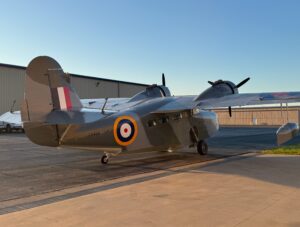
The museum obtain Grumman Goose N68157 in the Spring of 2026. It served with the RAF as FP488 based in Trinidad and Tobago. After its return to the U.S. after the war it went on to work in Alaska. It has flown over 20,000 hours!
General characteristics
- Crew: two (pilot and observer)
- Length: 38 ft 3 in
- Wingspan: 49 ft
- Height: 12 ft 2 in
- Empty weight: 5,320 lb
- Loaded weight: 7,500 lb
- Powerplant: 2 × Pratt & Whitney R-985 nine-cylinder radial engines, 450 hp
Performance
- Maximum speed: 195 mph
- Cruise speed: 175 mph
- Range: 795 mi
- Service ceiling: 24,000 ft
- Rate of climb: 1,490 ft/min